Understanding Language: Imprecision, Ambiguity, and the Mystery of Meaning
Language has some very fuzzy boundaries, but we seem to be stuck with them

Author’s Preface
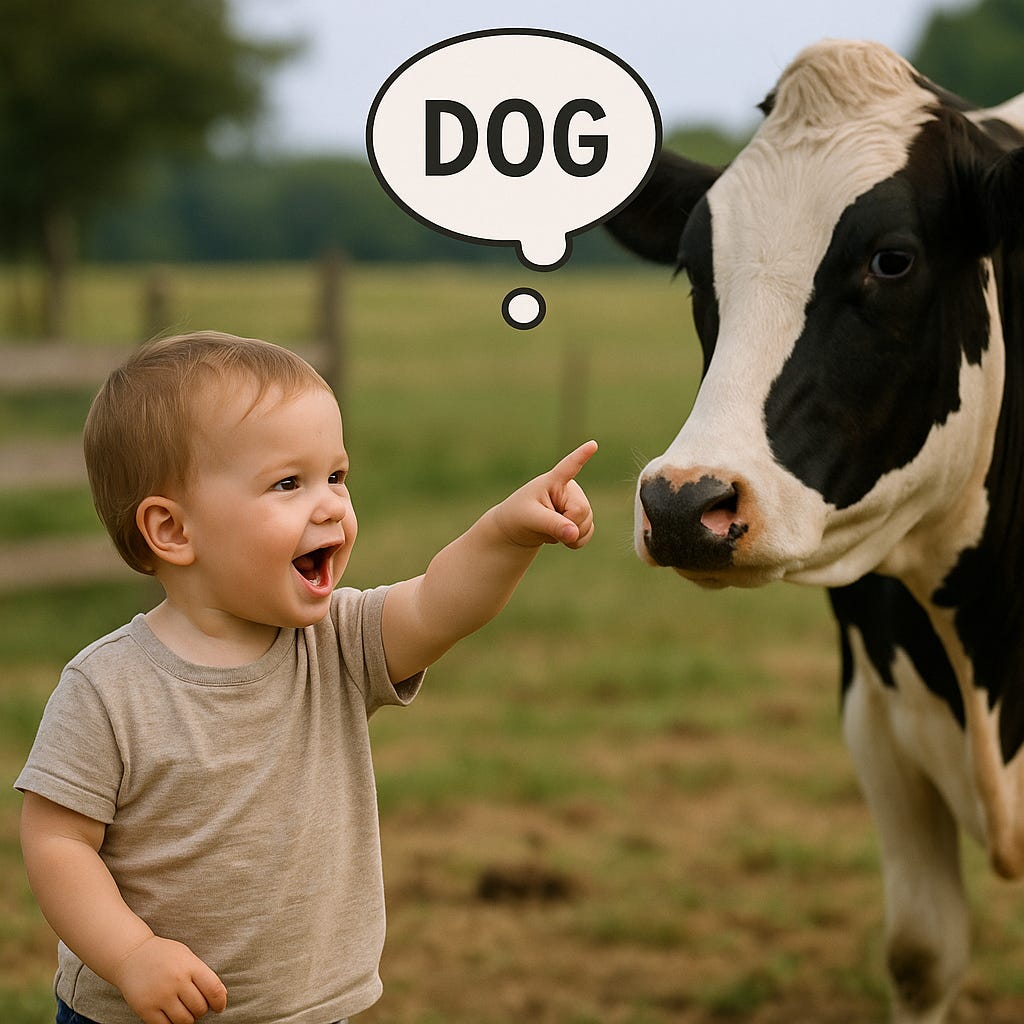
Language has fuzzy boundaries. That means it tries to categorize the world, events, things, other stuff, in ways that are not even remotely precise. It's hard to say just how it works at all, but it's surprising it does. Leads us into a lot of nonsense, of course.
We have all kinds of features of language. For instance:
1- we have polysemy
2- we have homonyms
3- we have antonyms
4- we have synonyms
They all create fuzzy boundaries, where meanings become imprecise. We have to determine what is meant by the context, and we sometimes get it wrong. Sometimes we get it drastically wrong, as in the idea of category mistakes or reification or equivocation, where polysemy allows us to use the word in one meaning and part of an argument and then change the meaning in such a way such that it's not recognized. Perhaps the arguer doesn't recognize it.
Language is an imperfect tool. That it works at all is really quite an amazing thing. It's a mystery, allied with the mystery of consciousness, the mystery of understanding, the mystery of meaning, and I don't mean dictionary meaning.
We have even more weirdness. We can rephrase things. We can paraphrase things. We can reword them. We can condense them. We can translate them into other languages, other dialects, and still preserve some essential components of the meaning. Not entirely, but some components. Sometimes we have to use a lot of roundabout ways, what we call circumlocutions, in order to do so, but we can usually do so. Imprecisely, perhaps, but we can do it.
There were proposals, I guess, in English analytic philosophy a few decades ago to clean up language. These failed. But we can have a thought experiment where you get rid of all synonymous words, which would be difficult to impossible, but you could do it as a thought experiment. And then you change words and create new ones so there are no more polysemous words. Every word refers to one thing and one thing only. And you clean up language in that regard. You get rid of synonyms. You get rid of polysemy. You get rid of homonyms.
Then you still have the problem of fuzzy boundaries. No matter how much you try, there are always going to be things where you have to decide where the boundaries lie. And that's inherent in our understanding of the world and in our use of language. So the whole project would be difficult, if not impossible. One could never learn a new language anyways. You'd have to start with a fresh slate and teach infants from the get-go the new language. So it's a thought experiment. Don't treat it as something we could actually do.
Introduction
This essay examines the inescapably imprecise nature of language. It explores how language fails to map cleanly onto reality, yet still manages to work. The discussion includes common sources of semantic ambiguity such as polysemy and synonymy, the problem of context-dependent meaning, the functional limits of translation, and the philosophical fantasy of a fully precise language. Central to this exploration is the idea that language, though flawed and fuzzy, remains one of the most astonishing and indispensable tools of human cognition. The argument is framed through a pragmatic lens: even though language fails to meet ideal standards of precision or formal rigor, it succeeds—more or less—in helping people function, think, and communicate in the real world.
Discussion
Fuzzy Boundaries in Language
Language, by its very nature, draws lines through the world—labeling objects, events, and qualities—but the lines it draws rarely match the contours of the world itself. Words like heap, bald, or game do not have clearly defined boundaries. The attempt to categorize real-world phenomena using discrete terms almost always results in blurry edges. Yet language still performs its function: people manage to use it, most of the time, without descending into total confusion. The surprise lies in this very functionality. As noted in the preface, it’s hard to say how language works at all, but the fact that it does—even amidst imprecision—is striking.
Semantic Features and Context Dependence
Several features inherent in language make its precision even more fragile:
Polysemy – A single word may carry multiple meanings, depending on use. For example, “run” can refer to motion, operation of a machine, or seeking political office.
Homonyms – Words that sound or look alike but have different meanings, like “bat” (animal) and “bat” (sports equipment).
Antonyms – These suggest opposites, but the line between them can be unclear; for example, the shift from hot to cold occurs through a gradient.
Synonyms – Words that appear to mean the same thing often differ in tone, emphasis, or social usage, such as child versus kid.
These features mean that language does not inherently carry meaning; interpretation is required. Context must be invoked to determine what is being communicated, and even then, people often misunderstand each other. In argumentation, such misunderstandings can be weaponized. Through equivocation, a speaker might shift the meaning of a word mid-argument without acknowledgment. Through reification, abstractions are mistakenly treated as concrete things. Through category mistakes, terms are misapplied to the wrong conceptual domain. These are not peripheral problems—they stem directly from the imprecise nature of the language system itself.
Language Is an Imperfect Tool
Despite these shortcomings, language does astonishingly well. That it enables thought, communication, and social coordination is remarkable, given its internal contradictions. Language is not a mirror of reality; it is an interpretive tool. It does not convey fixed meanings; it constructs provisional ones. And it does not stand apart from consciousness, but is bound up with it. As the preface puts it, the mystery of language is inseparable from the mysteries of consciousness, understanding, and meaning itself—and not just “dictionary meaning,” but lived, contextual, cognitive meaning.
Rephrasing and Translation
Language is also marked by its malleability. The same thought can be expressed in multiple ways—rephrased, paraphrased, condensed, or expanded. One can translate a sentence from one language into another, often preserving its core message, though never perfectly. Some precision is lost, and sometimes entire concepts must be reconstructed using circumlocutions—roundabout explanations in the absence of a direct equivalent.
The success of translation, even partial, is evidence of language's flexibility. Meaning can survive substantial shifts in form, structure, and vocabulary. This is one of the stranger aspects of language: it is both unstable and resilient. It allows interpretation across dialects, registers, and even languages, despite being far from exact.
The Thought Experiment of Linguistic Purification
In the mid-twentieth century, some analytic philosophers, especially within the English-speaking tradition, attempted to create clearer, more logical forms of language. The idea was to eliminate ambiguity and improve reasoning by constructing a purified linguistic framework. These efforts ultimately failed. But they left behind an intriguing thought experiment.
What would happen if all synonyms were eliminated? If every word had only one meaning, and every meaning had only one word? If all homonyms were removed, and new words were invented to fill every semantic gap without overlap? The resulting language would be formally tidy, with no ambiguity and no risk of equivocation.
And yet, such a system would be incredibly difficult to build, and likely impossible to use. Communication would slow down. Vocabulary would expand beyond memory. Nuance, metaphor, and flexibility would be sacrificed. Language would become a rigid grid rather than a living medium.
The Persistence of Fuzzy Boundaries
Even in this purified language, the deeper problem remains: fuzzy boundaries cannot be eliminated. The world does not provide crisp categories. Whether one is talking about colors, emotions, biological kinds, or legal definitions, the line between categories is usually blurred. No linguistic refinement can change that.
Moreover, such a language could never be adopted by existing speakers. Adults would be unable to shift to a fully unfamiliar, formally constructed language. A clean-slate approach would be necessary—starting from infancy, training children in a completely new linguistic system. That makes it a pure thought experiment, not a feasible reform.
But it serves a purpose. It highlights the extent to which our linguistic system is shaped by deep features of human cognition and reality itself. The imperfections are not accidental—they are baked in. They reflect how we think, how we perceive, and how we must interact with a world that refuses to conform to clean logical categories.
Summary
Language is a fundamentally imprecise tool, riddled with polysemy, homonymy, contextual dependency, and fuzzy boundaries. Yet despite these flaws, it remains serviceable—enabling communication, interpretation, and social coordination. Attempts to purify or systematize language, whether through philosophical reform or hypothetical redesign, run up against the inherent vagueness of the world and the way human cognition works. Precision, where it exists, is provisional. The deeper insight is that language succeeds not because it is perfect, but because humans are adaptable enough to work with its imperfection. The mystery is not that we sometimes misunderstand each other—but that, more often than not, we manage to understand anything at all.
Suggested Readings
Lakoff, G. (1987). Women, Fire, and Dangerous Things: What Categories Reveal about the Mind. University of Chicago Press.
→ A major work exploring the fluidity of categories and how language reveals conceptual structure.Pinker, S. (2007). The Stuff of Thought: Language as a Window into Human Nature. Viking.
→ Discusses polysemy, metaphor, and the cognitive mechanisms behind language use.Clark, H. H. (1996). Using Language. Cambridge University Press.
→ Investigates the pragmatic aspects of language, focusing on how people understand and coordinate meaning in conversation.Cruse, D. A. (1986). Lexical Semantics. Cambridge University Press.
→ Provides a technical but accessible discussion of word meaning, polysemy, and ambiguity.Austin, J. L. (1962). How to Do Things with Words. Harvard University Press.
→ Foundational work on speech acts, showing that language is not just descriptive but performative.Searle, J. R. (1979). Expression and Meaning: Studies in the Theory of Speech Acts. Cambridge University Press.
→ Explores how meaning depends on intention and context, with examples of ambiguity and miscommunication.