See: Intelligence Evolved at Least Twice in Vertebrate Animals
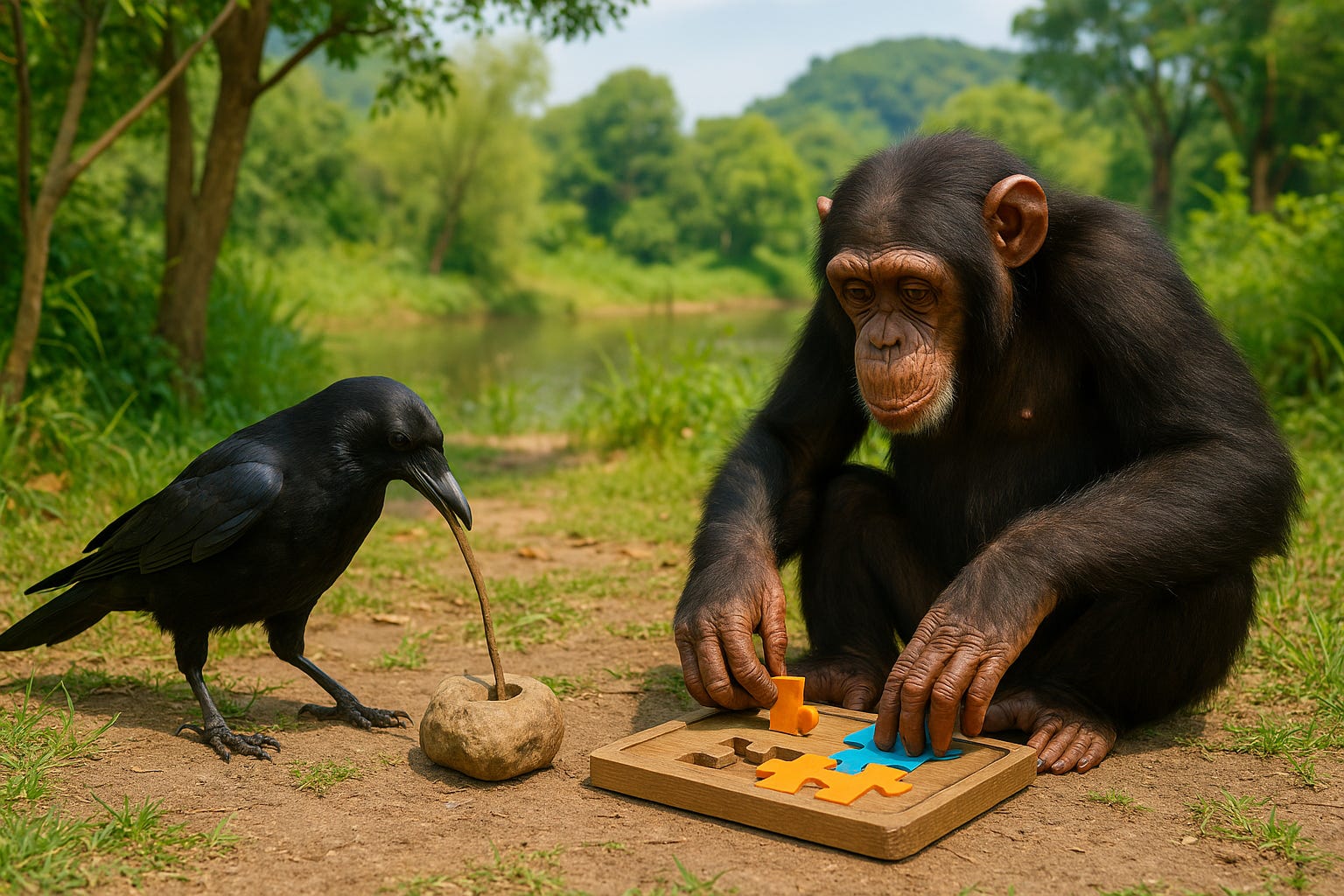
Complex neural circuits likely arose independently in birds and mammals, suggesting that vertebrates evolved intelligence multiple times.

See: Intelligence Evolved at Least Twice in Vertebrate Animals
Summary be ChatGPT:
Intelligence Evolved at Least Twice in Vertebrate Animals
New research suggests that complex intelligence in vertebrates (specifically birds and mammals) likely evolved independently, rather than from a common ancestor. Despite birds having smaller, structurally different brains lacking a neocortex, they display advanced cognitive abilities comparable to mammals (e.g., tool use, planning, problem-solving).
Historically, two main theories existed:
Harvey Karten argued that bird and mammal brain circuits are similar, implying a shared evolutionary origin.
Luis Puelles found that during embryonic development, the neural regions in birds and mammals arise from distinct parts of the brain, suggesting independent evolution.
Recent studies using advanced single-cell RNA sequencing tracked brain development in birds, mammals, and reptiles. Findings show:
Bird and mammal brains end up with similar neural circuits but are built differently, supporting the independent evolution theory.
Birds show surprising flexibility in brain development, with cells from different embryonic regions forming the same neuron types in adulthood.
Some genetic elements and inhibitory neurons are shared across vertebrates, indicating partial inheritance from a common ancestor.
The research highlights convergent evolution — like how birds and bats evolved flight separately. Vertebrate intelligence seems constrained to certain evolutionary pathways, but other animals like octopuses evolved intelligence through entirely different brain structures.
The findings challenge human-centric views of intelligence and open up new ideas for understanding cognition, both biological and artificial. Studying these diverse evolutionary paths could inform the development of new forms of artificial intelligence, potentially modeled on non-mammalian brains.
Corvids have neural density far greater than mammals. The neural structure is different, but functionality is similar. There is no "design". Evolution worked with whatever was available in each specie, improving the functionality. This burries theological "creationism" view that things are too complex to evolve incrementally. Often cited example of "eyes" - they too have been evolved many times, and some do not have blind spot like ours ..