Reason: On Language, Perception, and the Capacity for Abstraction
The Boundary Between Human and Animal Knowing

Of course, these are all everyday mysteries, but great mysteries, nonetheless. You don't think so? Perhaps you're just an incurious being.
Author’s Preface
The Reason series examines the ways in which human beings think, reason, and communicate, contrasting these with the capacities of other animals. Its purpose is to explore how perception, action, and symbolic thought fit together—and where they come apart. This essay arose from a set of reflections on the obvious but often neglected truth that the world exists and that animals, including humans, sense and act in it. From that starting point, the discussion turns to the differences between animals that operate without human-style language and the single known species that does. The interest here is not in idealized or speculative models, but in grounded, observable facts: the ways animals move, perceive, and interact with their environments; the ways humans turn perception into symbols; and the ways symbols sometimes lose touch with reality.
Of course, these are all everyday mysteries, but great mysteries, nonetheless. You don't think so? Perhaps you're just an incurious being.
Introduction
The essay begins from a premise so basic that it is sometimes overlooked: the world exists, it is objective, and it can be known. Animals—human and non-human alike—perceive and interact with this world. They do so without needing to name it, and their knowledge is embedded in action. The discussion moves through examples of animal perception and sensory diversity, the presence of categorization, motion detection, and causal understanding in many species, and the ways such capacities underpin their survival. It then considers the unique aspects of human language, including its ability to extend beyond immediate experience, to generate abstractions, and to produce both meaning and error. The final sections address the limits of animal communication, the possibility of fiction outside the human sphere, and the human tendency to build “towers of abstraction” that may float entirely free of reality.
Discussion
Existence of the Universe
There is a world. We call it the universe. We call it objective. It exists. If someone denies that, they are outside the scope of any serious discussion about what is real. Without that agreement, there is no shared frame for reasoning.
Animal Perception of the Universe
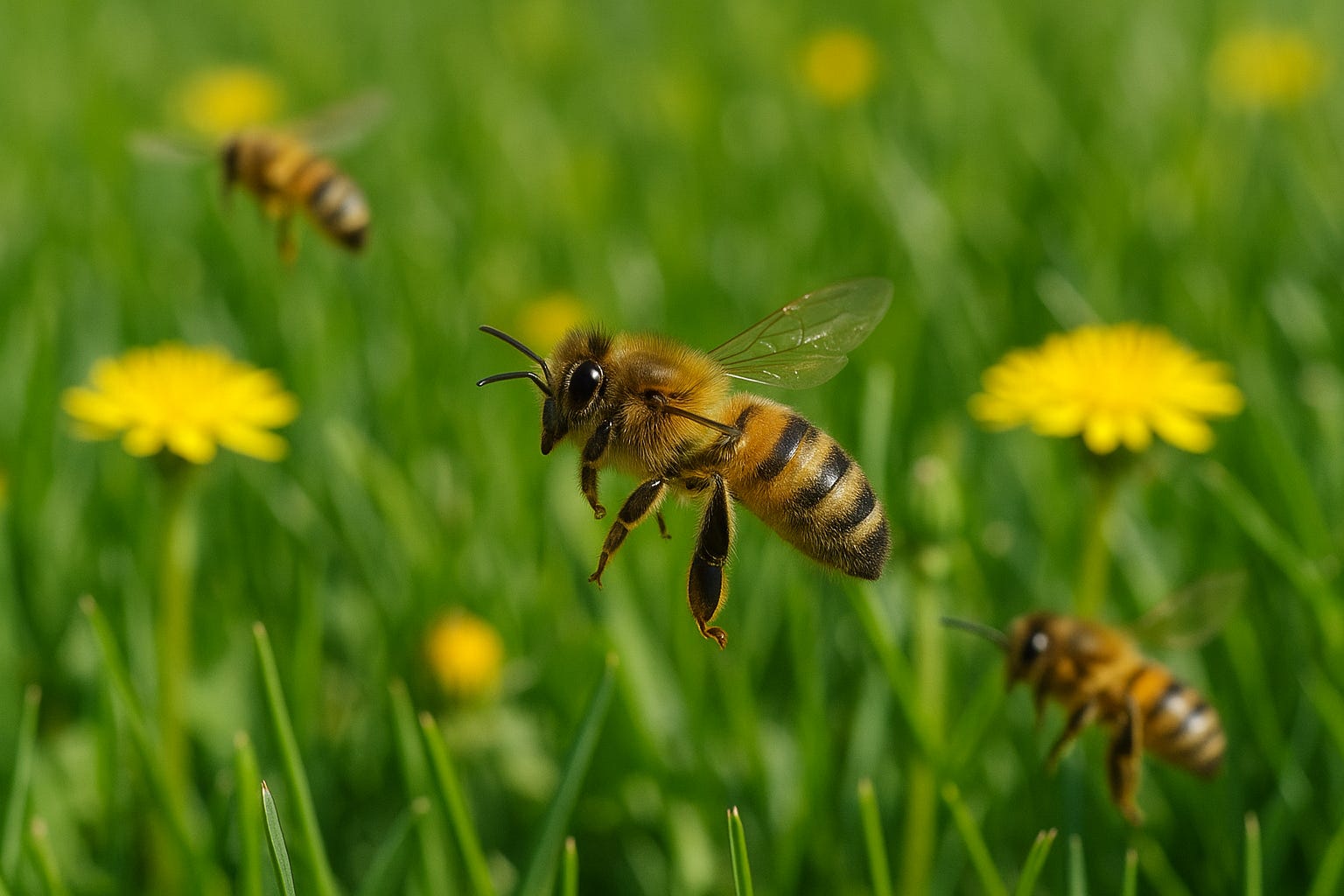
Animals sense this world and respond to it. A heron striking at a fish, a cat stalking a mouse, or a bee navigating back to its hive from a nectar source are all acts grounded in perception and interaction with the physical environment.
Distinction from Plants and Viruses
While plants respond to light, gravity, and touch, and viruses operate as biochemical agents, neither engages the world in the way animals do. A deer hears a twig snap and bolts; a wolf alters its pace to flank prey. These are fast, directed interactions shaped by immediate sensory input, not slow growth patterns or replication cycles.
Knowledge Without Language
An animal can know without speaking. A fox knows where rabbits emerge at dusk. A sea turtle hatchling heads for the ocean without verbal instruction. This is “animal sense”—knowledge embedded in perception and practice, not in symbolic representation.
Diversity of Animal Senses
Different animals inhabit different perceptual worlds. Bats map space through echolocation, owls hunt in near-darkness using acute hearing, and pit vipers detect infrared heat from prey. Migratory birds navigate thousands of kilometers using the Earth’s magnetic field. Such examples show that the range of sensory systems across animals far exceeds the human set.
Consciousness in Animals
The question of whether all animals are conscious remains open, but evidence from behavior suggests that many are. Crows solve multi-step puzzles, elephants appear to recognize themselves in mirrors, and octopuses manipulate objects out of curiosity. These point to awareness beyond reflex.
Perceptual Capacities of Animals
Animals detect figure and ground: a leopard hidden in foliage stands out to a monkey scanning for predators. They categorize: a pigeon distinguishes between pictures of trees and non-trees. They perceive causality: a dog learns that the sound of a can opener means food is coming. They register similarity and difference: a hen differentiates her own chicks from others. They even respond to quantity: a parrot can choose the larger pile of seeds without counting.
Spatial and Temporal Awareness
Animals navigate distance: salmon return to the streams where they hatched; ants follow scent trails to and from a nest. They exist in time: squirrels cache nuts in autumn for winter, showing anticipation of seasonal change.
Understanding of Material Things
Interaction with the material world often shows practical understanding. A chimpanzee strips leaves from a twig to fish termites from a mound. A sea otter uses a rock to crack open a clam. Such actions require an appreciation of how objects work and what they can do.
Human Linguistic Understanding
Linguistic understanding—layered, recursive, and symbolic—appears in full only in Homo sapiens. While other species have complex signals, they do not appear to generate or recombine them in limitless ways.
Non-Human Communication
Non-human communication is effective but bounded. Meerkats use distinct alarm calls for different predators. Dolphins produce signature whistles that function like names. Honeybees perform a “waggle dance” to indicate the direction and distance of food. These are specialized, highly adapted systems, but they are not open-ended in the way human language is.
Human Language Systems
Humans combine sounds, gestures, and expressions into a system that can describe yesterday’s storm, plan next year’s harvest, or speculate about events that never occurred. This ability to discuss what is not immediately present marks a major difference from other forms of animal communication.
Language and Deception
Deception is not unique to humans: a killdeer feigns a broken wing to lure predators away from its nest, an anglerfish uses a lure to attract prey. Humans, however, can deceive through language alone—persuading, misleading, or fabricating without any accompanying action.
Origins of Language
It is uncertain whether Homo sapiens invented language from nothing or inherited a proto-language from earlier hominins. The original language—if there was a single one—is lost to time. What is clear is that humans have invented many languages, each a complex, evolving system.
Abstract Concepts and Words
Words like matter, energy, space, and time are abstractions. They may have emerged to organize thought rather than to name immediately observable things. A culture might develop such terms after already having words for rock, river, sun, and self.
Development of Abstract Categories
At some point, specific words for concrete things expanded into general categories. “Stone” could become part of a broader category of “matter.” “Sun” might connect to a larger notion of “energy.” This step moves from naming the tangible to classifying the intangible.
Emergence of General Terms
Terms like matter, energy, space, and time enable broad statements about the world, but their equivalents may not exist in all languages. Some languages may divide reality along entirely different lines.
Cross-Linguistic Variation in Abstractions
Different languages reflect different worldviews. One might have no general term for “time” but instead use separate terms for cycles, seasons, and durations. Another might divide “space” into categories of navigable paths versus bounded areas.
Limits of Animal Language
Animals have limited language if “language” means open-ended symbolic communication. Linguists often deny that animal systems qualify as language at all. This may be less an empirical conclusion than a matter of definition.
Fiction and Deception in Animals
While animals can deceive, it is doubtful that they create fictional narratives. A spider may lure prey into a web, but this is not a crafted story. The human ability to create imaginary scenarios—whether a myth, a novel, or a false rumor—seems to have no close animal parallel.
Human Capacity for Untethered Abstraction
Language lets humans build “towers of abstraction” that may be loosely or entirely detached from reality. Economic theories, philosophical systems, and speculative cosmologies are examples. Some are useful; others collapse under scrutiny.
Meaningless or False Structures
Humans can produce elaborate systems of thought that have no external referent—alchemy, for instance—or systems later found to be wrong, such as the geocentric model of the universe. Animals can be mistaken, but without language they cannot construct multi-layered falsehoods.
Difference Between Human and Animal Error
Language changes both the scale and type of error possible. A human misconception can be preserved in books, taught to others, and reinforced by institutions long after it should have been discarded. An animal’s mistake, by contrast, tends to end with the individual or the immediate situation.
Summary
Animals and humans share fundamental perceptual and cognitive abilities: the capacity to detect motion, perceive causality, categorize, and navigate through space and time. Many species communicate effectively, sometimes with remarkable complexity. What separates humans is not the presence of these abilities but the way language multiplies and extends them—enabling planning, shared memory, abstraction, fiction, and deception on a scale no other species matches. This capacity, however, also expands the range of possible errors, allowing entire systems of thought to drift free from reality. The double-edged nature of language makes it both the greatest tool and the most dangerous liability of human cognition.
Readings
Lakoff, G., & Johnson, M. (1980). Metaphors we live by. University of Chicago Press.
— Explains how human concepts are shaped by embodied experience, with direct relevance to the shift from concrete perception to abstract categories.
Sebeok, T. A., & Umiker-Sebeok, J. (Eds.). (1980). Speaking of apes: A critical anthology of two-way communication with man. Plenum Press.
— Brings together case studies of animal communication, offering context for the limits and strengths of non-human signaling.
Tomasello, M. (2008). Origins of human communication. MIT Press.
— Describes the evolutionary path from gesture and shared attention to human-style language, with attention to what is shared with other species.
Hauser, M. D. (1996). The evolution of communication. MIT Press.
— Surveys animal communication across taxa, providing a detailed comparison with human linguistic systems.
Dennett, D. C. (1991). Consciousness explained. Little, Brown and Company.
— Considers how language transforms cognition and awareness, and how this affects human distinctiveness from other species.