Reason: Harold Opines
We are all Harolds to a large extent. A bug or a feature? I try not to be Harold, but it is a losing battle.

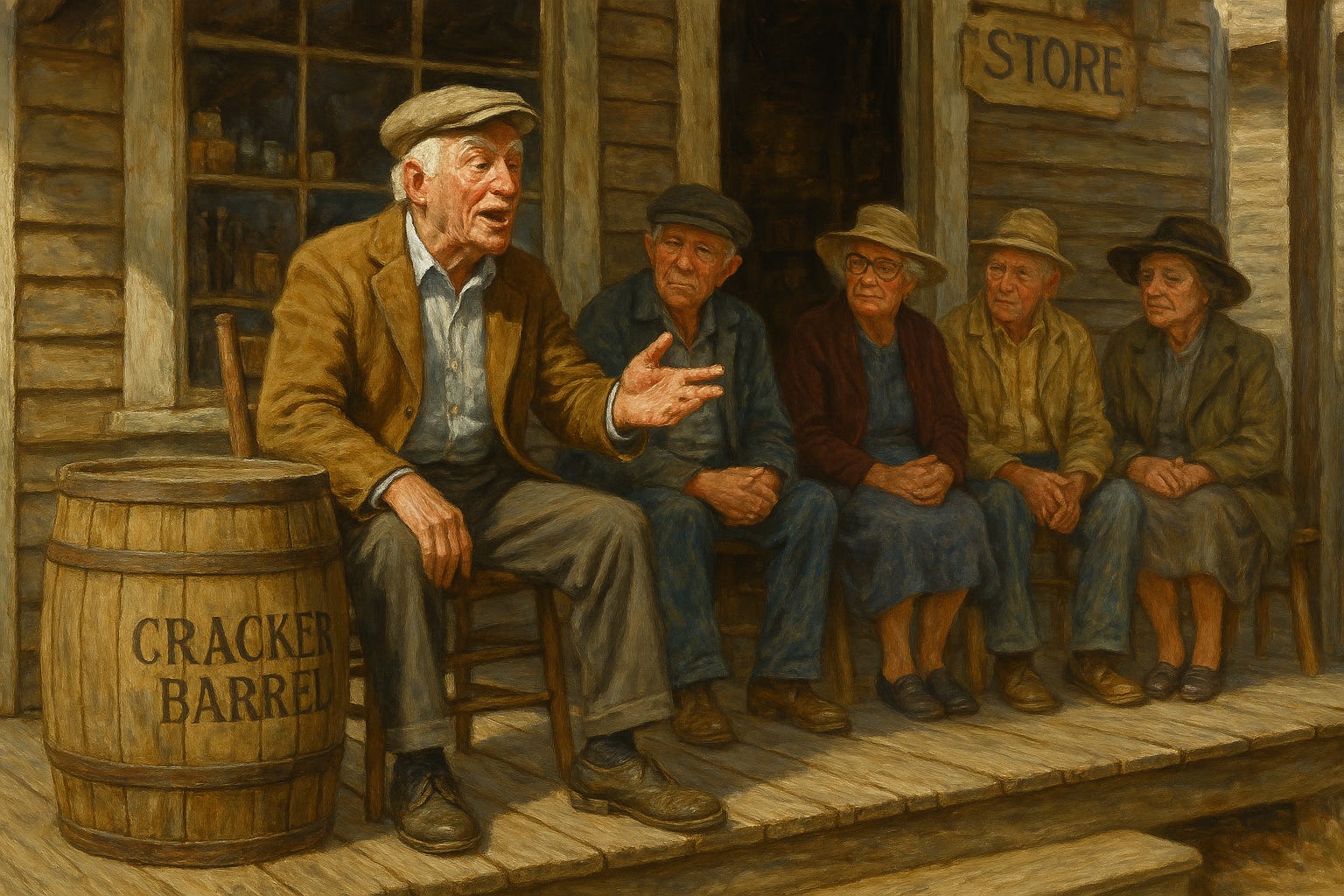
Note; my gifts, few as they are, are not literary. I did write the first paragraph. Such a cheater!
He was an old man, but life still had not knocked this self-assuredness from him. No matter how many times he'd been wrong in the past, he maintained a dogmatic certainty that he was always correct in his beliefs.
Harold Whitaker had built a lifetime on that certainty. He wore it like an old coat—patched, stained, but dependable. He could not imagine stepping outside without it. To shed it would be to expose himself to a chill he’d spent decades avoiding.
When the neighbors asked his opinion—on the weather, on the town council, on matters of national consequence—he delivered it without hesitation. His forecasts were wrong more often than not; storms that never came, policies that unfolded in precisely the opposite way he had predicted. Yet he spoke as if he had read the ending of the book before anyone else.
"Mark my words," he would say, raising a crooked finger, "they'll regret passing that ordinance. It'll ruin the whole town."
But the ordinance improved traffic, brought in business, and lowered taxes. Harold never acknowledged this. Instead, he found fault elsewhere, deflecting, twisting events to preserve the integrity of his worldview.
His friends had long since stopped arguing with him. Old Joe, who had known Harold since they were both boys with scabbed knees and scraped chins, simply nodded along these days. "You might be right, Harold," Joe would say, the words neither agreement nor challenge, just a way to keep the peace.
Deep down, Harold suspected—only dimly, like a half-remembered dream—that he might not be as infallible as he claimed. But to admit it, even privately, would unravel the whole fabric of his being. Doubt was a dangerous thing at his age. Doubt was the first crack in the dam.
So he pressed on, bracing himself against the tide of time and evidence alike. He carried his convictions with him on slow walks to the corner store, through the quiet afternoons on his porch, into the conversations with strangers who humored him out of politeness or pity.
There was a kind of dignity in it, or so he told himself. If he could not control the years as they slipped by, or the changing face of the town, or the erosion of his own body, he could at least control this: the certainty of his opinions.
And so, Harold Whitaker lived as he always had—undaunted, unbending, uncorrected.