Note: You don’t have to be a psychopath to be a good little Eichman. Note that Wikipedia is scarcely the most authorative source of anything, and is often propagandistic, but I think it will do in this case.
Note: I have no idea if the concept of a super-empath is to be taken seriously. I have not watched the video (at bottom), and it may be garbage. I throw it out there for consideration.
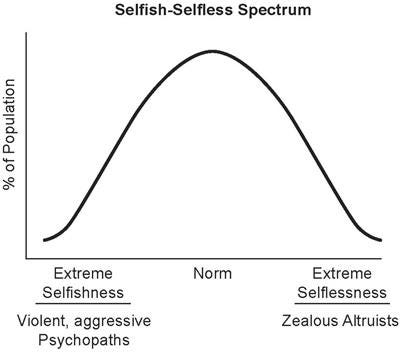
But empathy, if a real and measurable trait, it should be distruted in a population like any other measure, probably a normal distribution (bell curve) I suspect. I started trying to find such a curve. I found something - not at all convincing. But, we have real monsters, politicians, little Eichmans, used car salesmen, and presumably folks on the other end of the spectrum.
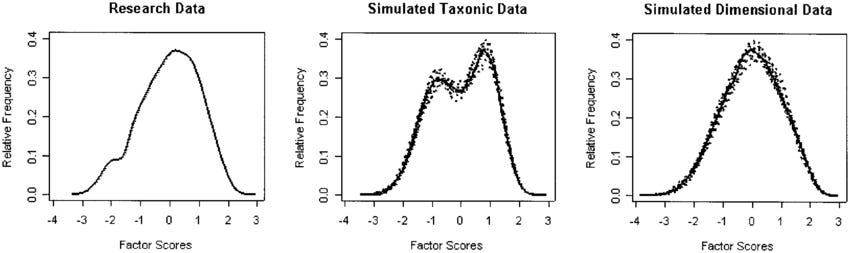
Latent mode factor analysis curves for the four Psychopathy Checklist—Revised facet scores and for the simulated taxonic and dimensional data sets. Each graph displays the frequency distribution of scores on the first factor of a factor analysis of the indicator set. The graphs for the simulated taxonic and dimensional data were produced by generating 10 data sets for each latent structure (dotted lines). The solid lines indicate the average of these data sets.
Psychopathic, Not Psychopath: Taxometric Evidence for the Dimensional Structure of Psychopathy
Article
Full-text available
Feb 2006
John F Edens David K Marcus Scott O. Lilienfeld, Norman G. Poythress
Although psychopathy is frequently regarded as qualitatively distinct from other conditions, relatively little research has examined whether psychopaths represent a distinct class of individuals. Using a sample of 876 prison inmates and court-ordered substance abuse patients who were administered the Psychopathy Checklist-Revised (R. D. Hare, 2003).
Heyokas
Note: Heyokas??? Seems hokey to me.
Here are 8 signs you are a Heyoka, the most powerful empath! Yes, there are different types of empaths, and the Heyoka (known as the sacred clown) is the most powerful one. The Heyoka empath is a contrarian, jester, and satirist who sees the world differently and goes against convention. These highly empathic people tend to react to situations surprisingly and unexpectedly and often use humor as a tool to get their message across. What's more, Heyoka empaths can mirror or reflect people's true personalities and traits back to them, allowing them to really see the person they are. Their conversations tend to result in you giving people advice, and people often feel inspired to change their lives after talking to them. If you suspect that you're an empath, but if you're unsure of the type, watch this video to learn more about the sacred clown personality and if you might be a Heyoka yourself!