Beyond GPT
Rise of Large Language Models

In conclusion, various LLMs with billions of parameters have been developed, offering high performance on NLP tasks. CALM, AlexaTM, LaMDA, ChinChilla, ESMFold, Gato, and WuDao2 are examples of such models. Understanding machine learning and programming languages like Python is essential for effectively utilizing these models.
Beyond GPT – Rise of Large Language Models
Summary
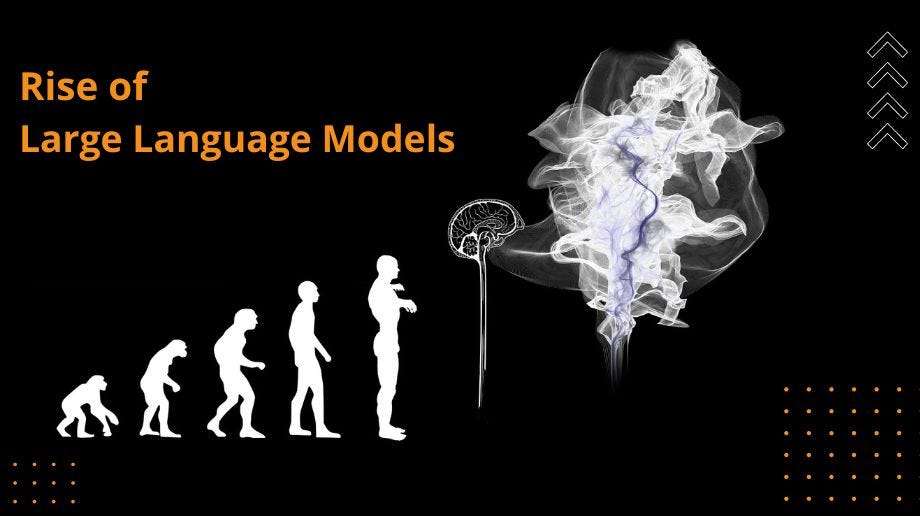
The rise of large language models (LLMs) has been remarkable, revolutionizing language processing and achieving high levels of accuracy and efficiency in NLP tasks. This rise is driven by the availability of annotated data, advancements in hardware, and software development. LLMs, such as GPT-3, are trained using unsupervised learning, predicting the next word based on the preceding context.
There are various types of LLMs, including unigram, bigram, trigram, and N-gram language models, which predict word probabilities based on different context sizes. CBOW and skip-gram models consider surrounding context words, while RNN and transformer models process sequential data. Deep learning and attention-based models also play a role.
Top alternatives to GPT-3 include GLaM, which uses multiple submodels for efficient processing; MT NLG with 530 billion parameters for superior performance; BLOOM, capable of generating human-like text in multiple languages; PaLM with 540 billion parameters and few-shot learning; BERT, an open-source model for understanding contextual word relationships; Transformer-XL for handling long sequences; XLNet, which models word context bidirectionally; RoBERTa, optimized for masked language modeling; T5, trained for various tasks like translation and summarization; ERNIE, trained for text classification; and XLM, designed for cross-lingual understanding.
LLMs have numerous use cases, such as translation, speech recognition, sentiment analysis, chatbots, and text summarization. There is no one-size-fits-all algorithm for large datasets, as the choice depends on the dataset and problem characteristics. Algorithms that process data in parallel, like those in distributed machine learning systems, are efficient for large datasets. Decision tree algorithms can handle large datasets sequentially but may be slower and less accurate for smaller datasets.
In conclusion, various LLMs with billions of parameters have been developed, offering high performance on NLP tasks. CALM, AlexaTM, LaMDA, ChinChilla, ESMFold, Gato, and WuDao2 are examples of such models. Understanding machine learning and programming languages like Python is essential for effectively utilizing these models.
Glossary of Technical Terms
Attention-based language models: These models use a mechanism called "attention" to weigh the importance of different words in the input sequence when generating text. Attention allows the model to focus on relevant information while generating responses.
Bidirectional Encoder Representations from Transformers (BERT): BERT is a powerful natural language processing model developed by Google. It understands the context of words in a sentence by considering the words that come before and after them, resulting in a deeper understanding of language.
Bigram language models: These models predict the probability of a word based on the previous word in the sequence. They consider pairs of adjacent words to make predictions about the next word in a sentence.
Cross-Lingual Language Model (XLM): XLM is a natural language processing model developed by researchers at Facebook AI. It has been trained on a large dataset and is designed to understand multiple languages, enabling multilingual language processing tasks.
Deep learning language models: These models utilize deep neural networks to process and generate natural language text. Deep learning models have multiple layers of artificial neurons that enable them to learn complex patterns and representations from data.
Dilated self-attention: It is a technique used in models like Transformer-XL to handle long sequences of data. Dilated self-attention processes the data in smaller chunks, allowing the model to capture long-term dependencies effectively.
Enhanced Representation through Knowledge Integration (ERNIE): ERNIE is a natural language processing model developed by researchers at Baidu. It has been trained on a large dataset and is designed to perform various language processing tasks, such as language translation and text classification.
Language modeling: It refers to the task of generating text that follows the patterns and structure of a particular language. Language models learn the statistical properties of a language by predicting the likelihood of words or sequences of words in a given context.
Large language models (LLMs): LLMs are advanced AI systems trained on vast amounts of text data to understand and generate natural language. These models have billions of parameters and excel in various language processing tasks like translation, summarization, and question answering.
Natural Language Processing (NLP): NLP is a branch of AI that focuses on the interaction between computers and human language. It involves understanding, interpreting, and generating human language, enabling tasks such as language translation, sentiment analysis, and text generation.
N-gram language models: These models predict the probability of a word based on the previous n-1 words in the sequence. N-gram models consider a sequence of n words to make predictions about the next word in a sentence.
Recurrent Neural Network (RNN) language models: RNN models use a type of neural network architecture designed to process sequential data. They have recurrent connections that allow them to capture information from previous time steps, making them suitable for tasks involving sequential data, such as language modeling.
Skip-gram language models: These models predict the surrounding context words based on a target word. Skip-gram models are commonly used in word embedding techniques like Word2Vec, where they learn to represent words as dense vectors based on their co-occurrence patterns.
Transformer language models: Transformer models use a type of neural network architecture specifically designed to process long-range dependencies in sequential data. They employ self-attention mechanisms that allow them to capture relationships between words regardless of their distance from each other, enabling better understanding of context.
Unigram language models: These models predict the probability of a word based on its individual occurrence in the dataset. Unigram models do not consider the context of surrounding words and make predictions based solely on the frequency